


Niemikotisäätiö got visited by Yusuke Tanaka, a Health Sciences student from the University of Tokyo. Tanaka had first been in contact with the foundation in early July, expressing his interest to learn more about Finland’s community-based mental health services and Niemikotisäätiö’s supported housing. The purpose of the visit was to gather background information for his research.
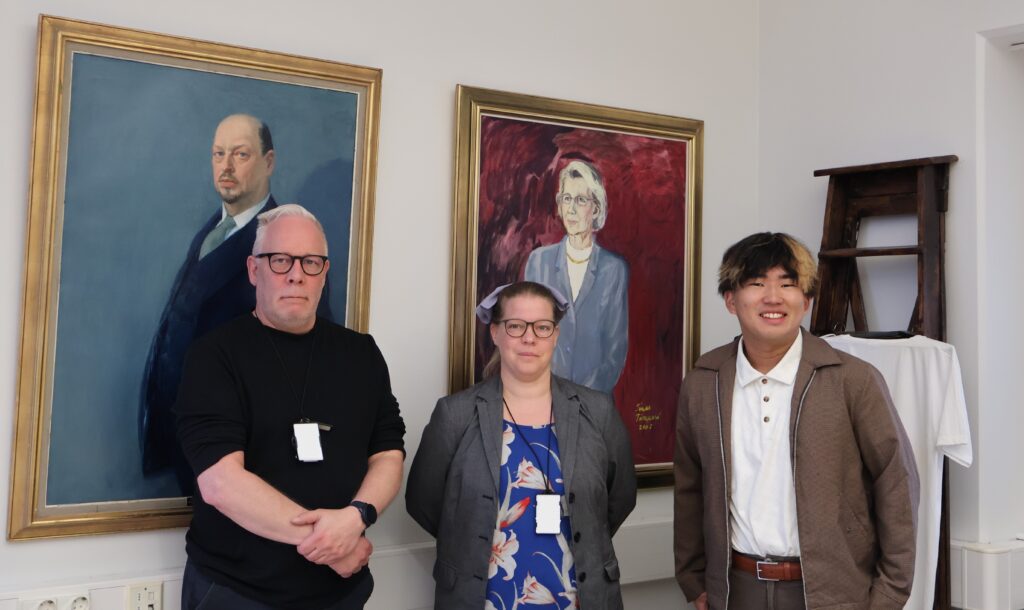
The meeting took place on a rainy Tuesday morning at Niemikotisäätiö’s administrative offices in Pasila, Helsinki. Despite the gray weather, our guest arrived with a warm smile and a friendly demeanour. He was welcomed by Senior Support Workers Satu Rintala and Joni Karlsson. Salmon-filled sandwiches, along with hot tea and coffee, were served during the meeting.
During his stay in Finland, Tanaka had explored Finnish mental health services and visited the Universities of Tampere and Helsinki, as well as Mielen ry in Tampere.
“I set this study trip as a comprehensive learning experience”, Tanaka explains. “I learned that the Finnish social health care is well-constructed in many ways.”
Interest in Finnish Community-Based Care
Tanaka’s research deals with the transition of mental health care from hospital-based services to community-based care. The origins of Niemikotisäätiö lie in this historical shift, and the foundation stood out while doing background research.
“I was looking for organisations providing actual mental healthcare infrastructure in Helsinki. I found that Niemikoti Foundation plays a massive role in offering comprehensive housing and rehabilitation as a non-profit organisation,” Tanaka explains.
The meeting covered Niemikotisäätiö’s rehabilitation services, communal housing, and the recovery-oriented approach in rehabilitation.
“The foundation doesn’t define “recovery” as just getting well from a disease or symptoms, but as empowering individuals to build a meaningful and hopeful life,” Tanaka explains his observations.
He particularly appreciated the ways that the foundation respects clients’ freedom of choice and individual needs: “It ensures that services are developed alongside the clients rather than just for them, making the support remarkably more inclusive and respectful.”
Cultural Connections and Professional Exchange
Several cultural connections were found during the visit. These included the foundation’s “Haiku”, a magazine produced by service users and named after the traditional Japanese poetic form, as well as gardens, and Japanese koi fishes found at the Skarppi unit.
During his visit, Tanaka had especially enjoyed Finnish saunas, coffee, and delicious salmon dishes.
From a professional perspective, however, there were some differences. Tanaka thinks that mental health care in Japan remains hospital-oriented, where clinical and acute treatments are highly accessible. In Finland, greater emphasis is placed on community-based services provided by third-sector organisations.
What could Finns and Japanese people learn from one another?
“In Japan, we have a lot to learn from your robust third-sector ecosystem that provides continuous, low-threshold housing and peer support,” Tanaka reflects.
“Conversely, Japan’s extensive hospital network might offer insights into securing immediate medical safety nets,” Tanaka adds.
An Inspiring Visit
Tanaka left the meeting with a wealth of information and a collection of Niemikotisäätiö publications. The gains of the meeting, however, were mutual. The exchange of experiences and intercultural dialogue brought fresh perspectives and inspiration to everyone involved. Tanaka also brought delicious “Tokyo Banana” cakes as a thoughtful souvenir.
Niemikotisäätiö would like to thank Tanaka for his visit and wish him the very best in his studies!
